
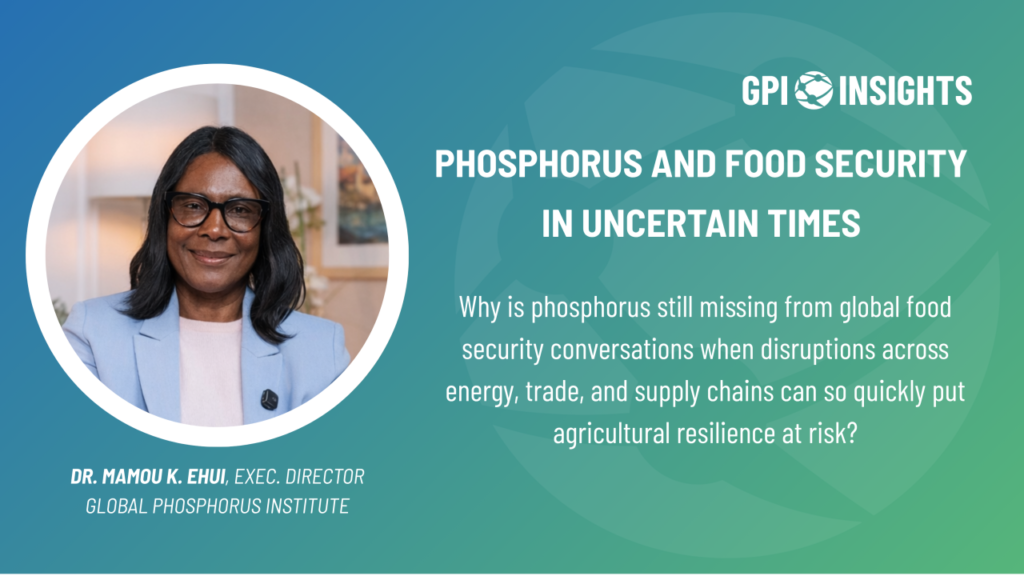
By Dr. Mamou Ehui, Executive Director of the Global Phosphorus Institute
Food security is shaped by far more than what happens on farms. Developments across energy markets, trade routes, commodity supply chains, and strategic raw material systems all influence agriculture’s capacity to feed a growing world. When global uncertainty rises, public attention tends to focus on energy, cereals, and trade flows—often overlooking a broader category of strategic inputs whose role, though less visible, is no less critical. Among these, fertilizer—and particularly phosphorus—holds a central place.
Recent international analyses have shown how disruptions in maritime routes, energy systems, and broader market conditions can create cascading effects on fertilizer markets, with disproportionate consequences for vulnerable economies. These developments point to a structural reality: the resilience of food systems depends as much on the stability of the systems that sustain agricultural inputs as on agricultural production itself.
Phosphorus: A Strategic Resource
Phosphorus occupies a singular place in the global food system. From mines to processing plants, from ports to farms, it moves through a supply chain that depends on stable energy, reliable transport infrastructure, adequate industrial inputs, sound financial conditions, and uninterrupted trade. Each link in this chain represents a potential point of vulnerability.
As one of the three primary macronutrients required for plant growth—alongside nitrogen and potassium—it has no substitute. Without reliable access to phosphorus-based fertilizers, the ability to sustain soil fertility and maintain crop productivity is constrained.
How Global Shocks Affect Phosphorus Systems
The effects of global instability on phosphorus fertilizer systems operate through a combination of interconnected pathways:
- Market uncertainty and price volatility: Procurement decisions are time-bound and linked to agricultural calendars. Prices can rise driven by perceived risk and precautionary behavior.
- Energy and industrial cost pressures: Production and distribution rely heavily on energy. For example, sulphur is essential for producing phosphoric acid; changes in its supply or pricing directly affect output levels.
- Shipping and trade disruptions: Maritime insecurity, logistical bottlenecks, and rising insurance costs can delay or constrain fertilizer flows.
- Macroeconomic and fiscal pressures: Inflation, debt pressures, and exchange-rate volatility reduce the ability of governments and importers to finance purchases at critical moments.
- Policy responses under uncertainty: Countries may prioritize domestic supply or adopt protective measures that tighten global markets further.
From Input Stress to Food System Risks
The implications are most severe where agricultural systems already face structural constraints—low soil fertility, limited input use, and underdeveloped distribution networks.
When fertilizer prices rise, farmers often respond by reducing application rates or forgoing fertilizer use altogether. The immediate result is lower yields and increased vulnerability. Over time, these effects lead to a gradual decline in soil fertility—an accumulative process that extends well beyond a single production cycle.
Uneven Exposure: Who Bears the Greatest Risk?
While these dynamics are global in origin, their impacts are unevenly distributed. Regions that depend heavily on fertilizer imports and have limited fiscal capacity are particularly exposed to disruption.
These patterns are especially evident across many African countries, where improving soil fertility remains a central challenge. Strengthening the resilience of input supply systems is critical to sustaining agricultural performance and food security outcomes in these contexts.
Conclusion
Phosphorus is fundamental to food production, yet it remains underrepresented in high-level discussions on food security. Fertilizer systems sit at the intersection of energy markets, trade dynamics, logistics networks, and financial systems.
The evidence is clear: in a context of increasing global uncertainty, placing phosphorus at the centre of food system thinking is no longer optional—it is essential.
Reference List
- UNCTAD (2026). Hormuz shipping disruptions raise risks for energy, fertilizers and vulnerable economies.
- IFPRI (2026). The Iran war’s impacts on global fertilizer markets and food production.
- IFPRI (2026). Who’s afraid of high fertilizer prices?
- IFDC (2026). Fertilizer Crisis Response Bulletins.
- S&P Global (2026). Middle East war impacts global food security over fertilizer, fuel and freight issues.
* This GPI Insight provides a concise and accessible perspective on the importance of phosphorus to food security in a context of growing global uncertainty. Rather than a technical market or impact analysis, it highlights how disruptions across interconnected systems can affect phosphorus fertilizer access, affordability, and ultimately food production.